A Guide to Water Flow Rates
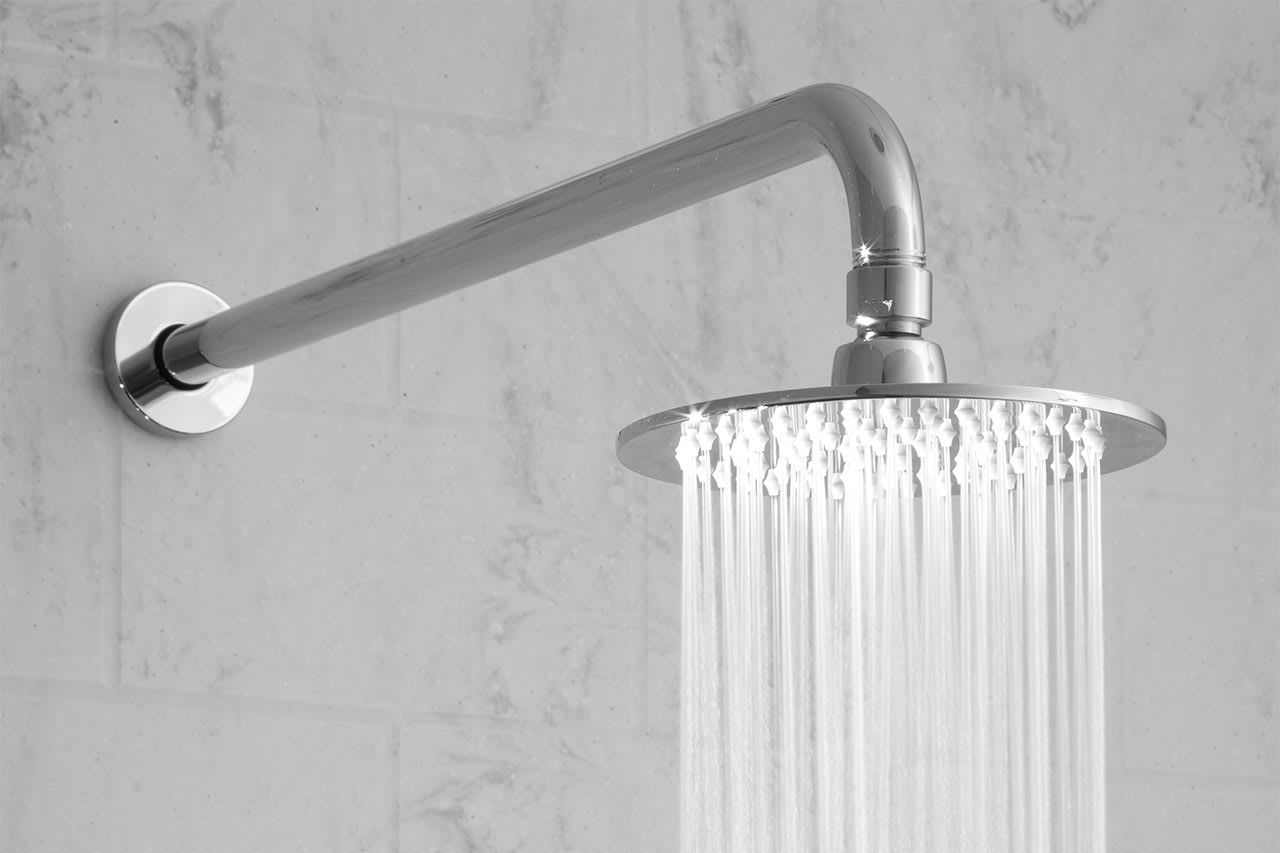
Go with the flow. Learn everything you need to know to achieve that sought-after water pressure - we’re talking GPM, aerators, low flow faucets, and your water bill.
Water bills sending you through the roof? Selling your home? Evaluating your home’s efficiency? Installing a new water heater? Unsatisfied with your water pressure?
Those are all compelling reasons to learn about your household’s water flow rate.
The Environmental Protection Agency (EPA) estimates that showers consume 1.2 trillion gallons of water every year in the United States; kitchen and bathroom faucets account for 19% of the average home’s water usage. To keep your bills low and your home environmentally friendly, take a closer look at your faucets’ and shower heads’ flow rates to learn how you can conserve and save.
Plus (and this is the factor that matters most to many of us), some low flow shower heads just don’t deliver that must-have water pressure.
If you’re the person whose eyes glaze over as soon as the unfamiliar terms start rolling in, don’t leave this page – this guide is for you!
Terms to know before you read:
GPM: gallons per minute (units in which water flow rate is measured)
PSI: pounds per square inch (units in which water pressure is measured)
Aerator: a simple device that restricts the flow rate on a faucet or shower head
The answers to your most common questions and concerns are right here, simplified so that even the least handy among us can benefit.
How much water per minute does a faucet use?
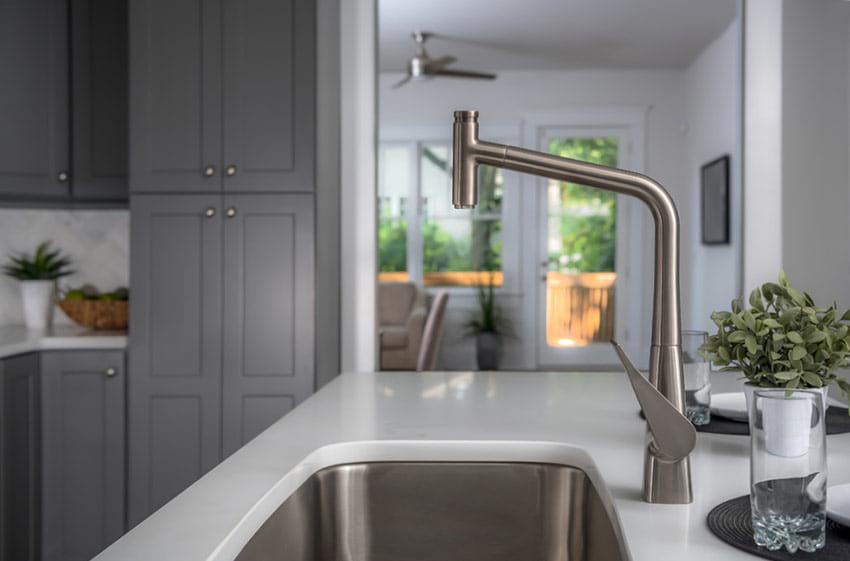
The average faucet flow rate depends on the age of the fixture. According to federal regulations, all kitchen and bathroom faucets should have a maximum flow rate of 2.2 gallons per minute (gpm) at 60 psi (pounds per square inch) of pressure; in California and Georgia, maximum flow rates are further restricted to 2.0 gpm (California will eventually be restricted to 1.8 gpm).
Many bathroom faucets flow at a rate of 1.5, 1.2, 1.0, or 0.8 gpm without a noticeable reduction in what most of us refer to as “water pressure.”
Older faucets may use more water than newer fixtures and can be fitted with an aerator for conservation.
What is the average flow rate of a bathtub faucet?
Tub faucets do not require flow restrictions like kitchen faucets and shower heads. That’s because kitchen faucets and showers tend to run continuously, while tub faucets are turned off once the tub is full – and a flow restrictor would just increase the amount of time needed to fill the tub.
Most tub faucets run at approximately 4 to 7 gallons per minute.
How many gallons per minute does a garden hose use?
The garden hose flow rate depends on several factors, including the length and diameter of the hose and your home’s water pressure. The best way to determine your hose’s flow rate is to use the measuring technique outlined below.
What is the best flow rate for a shower?
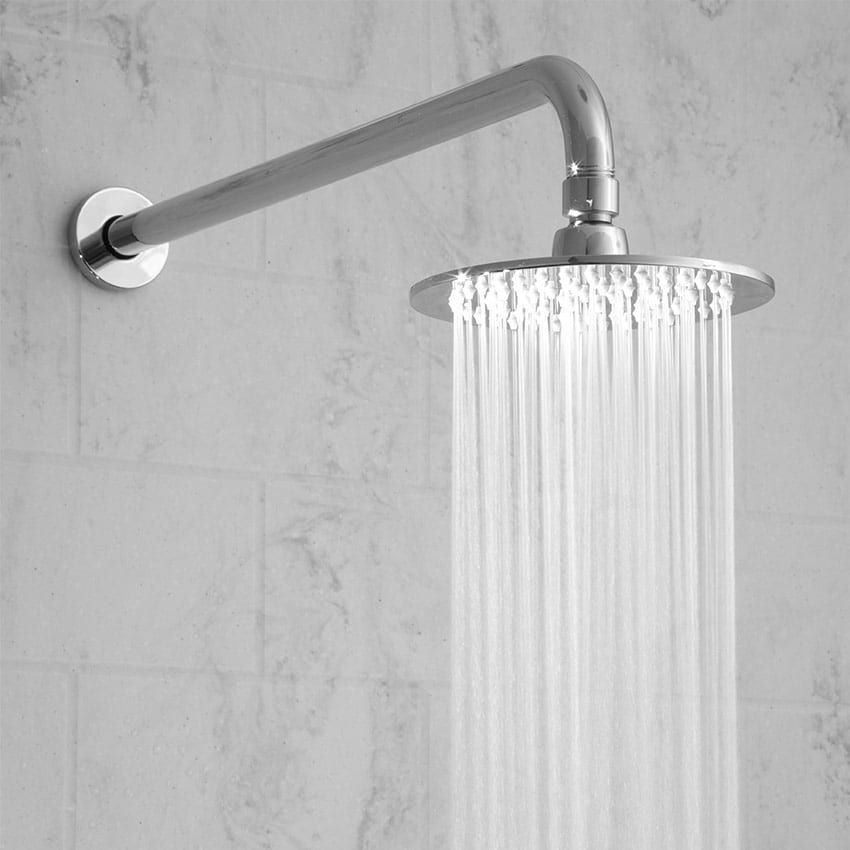
Prior to 1994, the average shower head used 5.5 gallons per minute (gpm) of water. Federal regulations now restrict shower heads to 2.5 gpm; in California, the maximum flow rate is 2.0 and will be further lowered to 1.8.
What is a low flow shower head?
A low flow shower head is a shower head specially designed to restrict the flow without affecting the shower experience. Look out for shower heads (and faucets, toilets, and other fixtures) with a WaterSense label that indicates that the fixture is water-efficient; WaterSense-certified products use no more than 2 gpm.
Low flow shower heads are designed to deliver a satisfying, comfortable shower at a lower flow rate. While you conserve water, you’re not sacrificing the water pressure that you’ve come to love.
Is a low flow shower head less powerful than a regular shower head?
That’s a common misconception. A lower flow rate does not mean that your shower will have less pressure. Water flow (gpm) refers to how much water is coming out, not how fast or how hard it’s coming out. On two shower heads of the same size, the head with a higher gpm rate will have more pressure; if you have two shower heads of different sizes with the same flow rate, the smaller shower head will often provide better pressure than the larger one, so be aware of that factor before purchasing a large rainhead (designed to provide a gentler shower).
Some shower heads are designed to provide higher pressure even with an EPA-compliant flow rate, like the Jaclo Rain Machine “power shower” head.
How much money do you save with a low flow shower head?
That depends on your water rates, your existing shower head, the type of low flow shower head, and your showering habits. If your low flow shower head does not provide a powerful enough stream, you may end up taking longer showers and using just as much water – check reviews on the shower head before buying.
Simply replacing an old aerator can help you save up to 40% of your water. Considering that an aerator can cost as little as $1, it’s a worthwhile investment!
How do I measure my faucet’s water flow rate?
Even if your shower head has a flow rate of 2.5, the actual flow rate may differ once it’s in your home. That’s because your home’s water pressure may be higher or lower than the 60 psi at which your fixture is designed to deliver 2.5 gpm.
Measuring the flow rate of your faucet or shower head is easy. You’ll need a container large enough to catch all of the water (a larger container is recommended for shower heads), a measuring cup, and a stopwatch. Turn on the cold water at full blast, then set your timer for 10 seconds. Start the timer and place the container under the water at the same time (that part’s important!) and turn the water off at exactly 10 seconds. Use your measuring cup to measure the water you collected, convert to gallons, and multiply by 6 (for 60 seconds).
Alternatively, use a gallon-sized container and check how long it takes for your fixture to fill the container. If it takes less than 24 seconds, you’d benefit from a more water-efficient fixture.
What is an aerator?
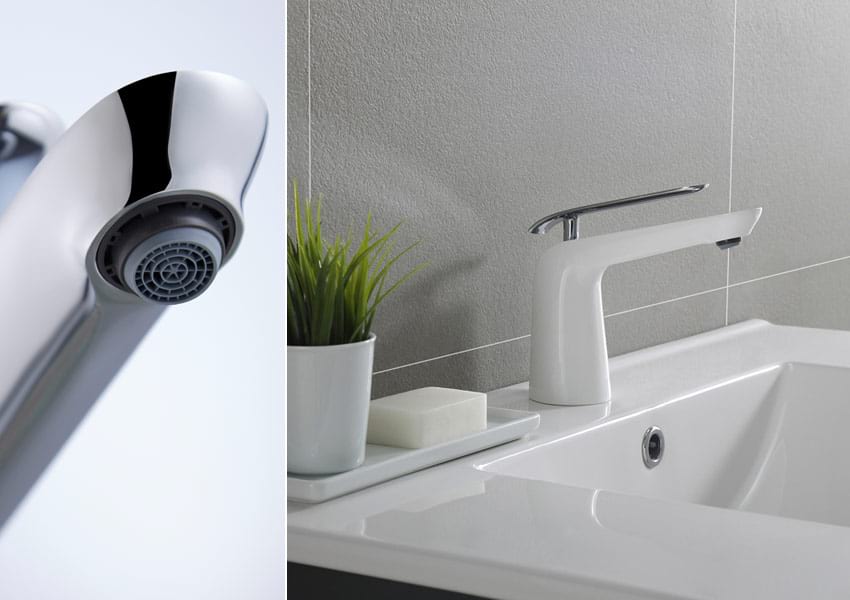
A faucet aerator, also known as a flow regulator, is a small attachment that is screwed onto the end of the tap or inserted into the spout.
How does a faucet aerator save water?
Aerators work by mixing the water with air, separating the single stream of water into numerous smaller streams like a sieve. This effectively introduces air into the stream, reducing the amount of water coming through the faucet without reducing the pressure of the flow, so you’ll still get your high-powered shower without wasting water.
How do I remove the aerator from my faucet?
The aerator can occasionally get clogged, especially on a kitchen faucet or in a location with hard water. Depending on the location of the aerator, you may have to merely unscrew it from the head of the faucet or remove the sprayer head to access the aerator. Often, weak water flow can be attributed to a clogged or dirty aerator; simply cleaning it out with water or vinegar can be an easy fix to restore your flow.
Why is flow rate restriction important?
In addition to saving water and lowering water bills, a reduced flow rate also reduces the amount of fuel needed to heat the water. Bonus: lower energy bills, too!